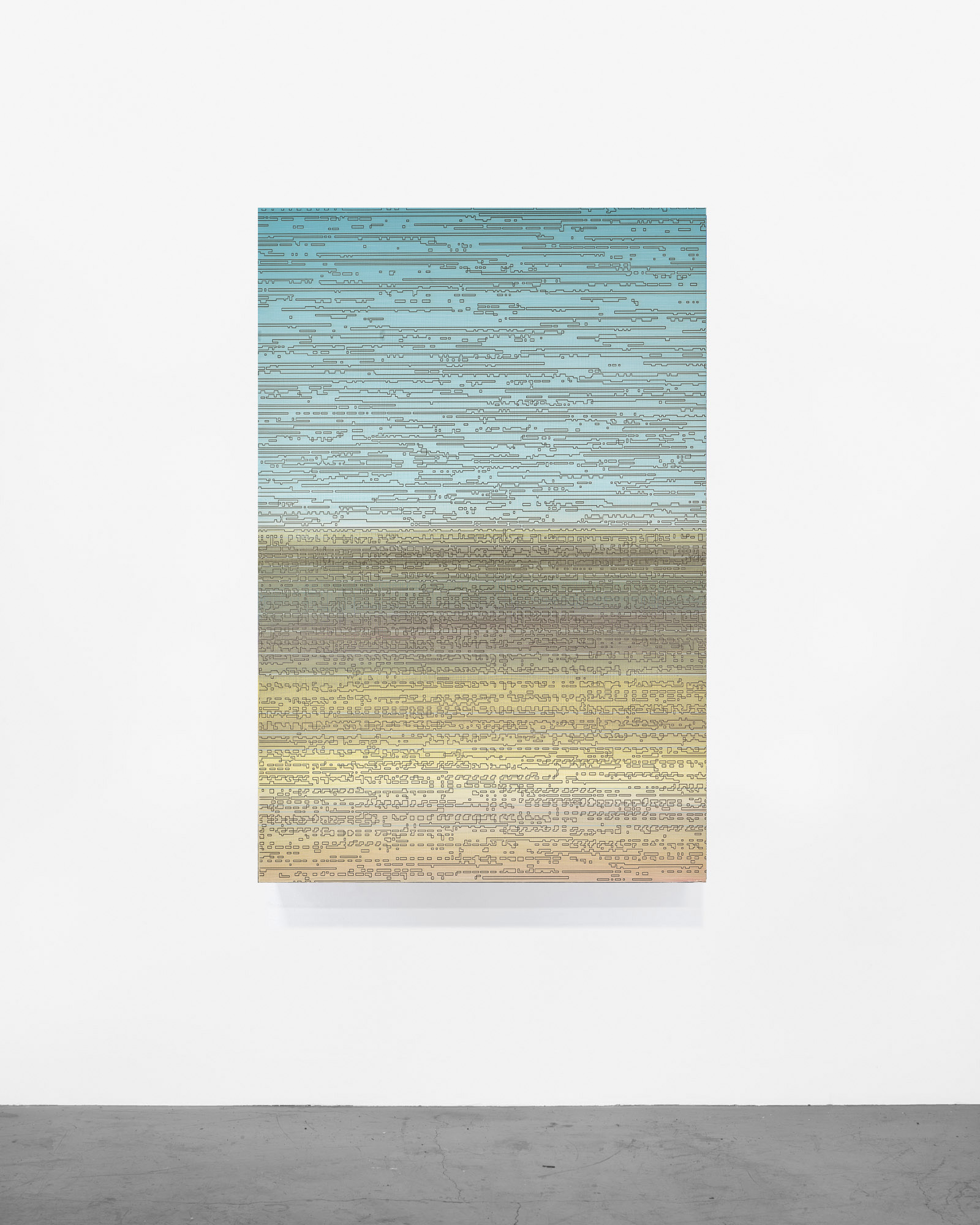
"Can you remember a specific sunset — I mean, really?" asks abstract expressionist artist John Vokoun. It begs the question: how do we remember things? Can we conjure the precise colors, textures, or resonance of a moment? "I'm trying to make paintings that describe the energy of experience," says Vokoun. He does it by breaking down experience into data and color points — say, reconstructing a sunset through bands of moving lines (or waves or particles).
Vokoun grew up near St. Louis, Missouri, where he spent a good amount of high school cutting class and drawing in the park or city museums. The mid-career artist has spent the last two decades in New Mexico, where the landscape has shaped his art. Obsessed with detail and precision — even when it comes to addressing subjective experience — he uses a variety of media. Though the result is generally a painting in acrylic, oil, or lately, encaustic — underneath might be a laser-cut panel with undulating geometric patterns that were designed for machine execution.
He's one of those artists who give pause to define. Is he a digital painter? Indeed, Vokoun went to computer camp as a kid and geeked out on programming and taking apart/rebuilding computers. He studied art and philosophy in college and went on to run a pre-press and printing business for years. Meanwhile, he acquired the digital tools to scramble data and rearrange it into abstract forms. "I'm fascinated by how we remember things," he says. "It's never like a photograph. There are weird impressions and feelings, like patterns and shapes, and it's more emotional."
Vokoun's practice originates in an early experience he had in New Mexico, when he was taking digital photographs in Abiquiu. By chance, these came out distorted and abstract, their pixels corrupted. This prompted him to start fiddling with image data intentionally. After all, who says we have to — or even do — experience the elements of a scene "in order" or "as a whole"? Now, well past the point of glitch art, he's developed a repertoire of geometric forms — a language of subterranean, or subliminal, if you will, currents.
Interestingly, the most transformative experience he had with art as a child was when he first saw pointillist paintings during a family trip to the Chicago Art Institute. "I just spent so much time staring at this one painting, running back and forth. I guess what I do now is technological pointillism," he laughs.
While the computer allows for quick work of replication, scale, and inversion, Vokoun's compelled by the accidents and imperfections of what's done by hand. Often he starts with graphite, lured by "the purity of pencil and paper." He works out a rhythm and scale that he then reproduces with CAD software to create a vector file. He'll go back and forth between digital and painted compositions, finally producing sculptural paintings that reflect and play with the dynamics of perception.
A few years ago, Vokoun spent a month at Chaco Canyon on a National Parks art residency. His paintings Chaco Landscape (recently featured in Hyperallergic) and Structure of a Sunset are testament to what he witnessed there.
"You get a sunset and it's a big vista," says Vokoun. "There are all these layers of Earth and sky, and our eyes keep moving back and forth to take it in. When you think about all those little bits and try to track your eye movement, it's hard to see the whole scene. It fascinates me how our brains can take all these details and turn that into a memory."
Structure of a Sunset interprets a mid-October evening in Chaco, when twilight emerged in a soft gradient without drama. He uses white to represent fluffy clouds passing through a dome of sky, which takes up the better part of the composition. The brown earth has turned green in the blue light of this sunset, and a band of red indicates the horizon line. "There were layers of earth floating through different strata of pigment, matter, and light," he says. "I wanted to explore the structure of that data."
Interestingly, Vokoun uses a portrait orientation to provide a vertical slice of this expanse. He combines contrasting color bands to capture "the balance and spacing of an impression of that place and time." Yet harmony isn't necessarily what he's after. "The things I paint have a little discord, which leads to visual excitement. In a normal scene you don't have spots of tonality going from light to dark or heavy values that fast. Things gradiate more. But the contrasts give a sense of undulation that I think reflects how our eyes constantly move and refocus through a scene or an experience."
While at Chaco, Vokoun spent time with archeologists and guides, learning about the place's history and geo-astronomical construction. "It's strange to put into words, but there are some places on this planet where you can almost feel a vibration coming up through your body," says Vokoun. "There's a bizarre energy and spirituality to the place that I could never paint."
A similar dynamic happens, proposes Vokoun, with people. "Everyone is like an amazing instrument, and each individual is crafted so uniquely," he says. "When people attenuate, the energy between them is totally unique — like a color in a palette that can't be reproduced. I think we're different in every combination we find ourselves in."
The idea translates to the relational principles of visual perception. "When two complementary or secondary colors are put next to each other, the color relationships interfere with our minds. Due to the fact that our eyes can't hold still, colors leach into each other and it creates a blending of things."
Along those lines, how we relate to a place — and how we might even come to revere it, Vokoun notes — totally depends on how we perceive it. Chaco Canyon, for instance, is a national monument of enormous cultural importance, but it's surrounded by encroaching oil drills. "What we are sacrificing is not just the land itself, but also the spirit a bit, by saying this isn't important to us," says Vokoun. "There can be so many interpretations about what happened culturally at a place, which shows how radically differently we experience it. But sometimes when you stare out into space, into sky or landscape, you can get overwhelmed with this sense of something harmonious and pure and beautiful. I think that we are part of that in mysterious ways."